 Українська
  English
Вступ
The Ukrainian language holds a significant place in the identity and cultural continuity of its people. Historically, it has faced numerous challenges, enduring attempts to limit its use and reduce its presence in public life. These efforts aimed to dilute the distinctiveness of Ukrainian culture by minimizing the role of its primary vehicle of expression: the language itself.
Despite such obstacles, the Ukrainian language has not only persevered but has become a symbol of resilience and unity. It connects generations, carrying the rich tapestry of national traditions, folklore, and literature that define the Ukrainian spirit. The language’s survival and flourishing, especially in the face of attempts to suppress it during periods of foreign domination, underscore the strong will of Ukrainians to preserve their cultural heritage.
In contemporary times, the Ukrainian language is a vibrant and essential component of Ukraine’s national identity. It is a marker of the nation’s historical journey, its ongoing struggles for sovereignty, and its aspirations for the future. The story of the Ukrainian language is a narrative of endurance and revival, highlighting its crucial role in the cultural and social fabric of the Ukrainian people.
Historical Attempts to Suppress the Ukrainian Language
The Ukrainian language has encountered numerous challenges throughout its history, particularly from policies designed to suppress its use. These attempts to minimize the language’s presence and impact began during the Tsarist Russia era and continued into the Soviet Union period. Today, they persist amid the full-scale war and in territories occupied by Russia, where Ukrainian language and culture face direct suppression as part of broader efforts to erase Ukrainian identity and sovereignty.
During Tsarist Russia, a series of edicts and policies aimed to reduce the public and educational use of Ukrainian, effectively trying to phase it out in favor of Russian. This effort to Russify Ukraine sought to assimilate its culture and erase its unique linguistic identity. Schools, publications, and public life were targeted to ensure the dominance of the Russian language.
The suppression of the Ukrainian language was not uniform across all ruling empires. In regions under the Austro-Hungarian Empire and Poland, Ukrainian language usage was somewhat tolerated in everyday life and cultural expressions. However, this leniency did not extend to the realms of academia, politics, or any official domains. In these spheres, Ukrainian was conspicuously absent, as the ruling authorities favored German, Polish, or other dominant languages for administrative, scholarly, and political discourses. This selective tolerance highlighted a nuanced form of cultural suppression, where Ukrainian identity was allowed a measure of expression but was systematically excluded from the structures of power and influence.
The Soviet era brought no relief to the cultural suppression experienced under Tsarist rule; instead, it introduced a new dimension to the Russification process. Beyond stringent language policies, the Soviet government engaged in the deliberate resettlement of populations to dilute Ukrainian national identity. Thousands of Russian natives were settled across Ukraine, integrating Russian language and culture into the local fabric, while numerous Ukrainian families were deported to Siberia, further fracturing the Ukrainian cultural presence. These actions, coupled with severe crackdowns on “nationalist deviations” in the 1930s, including stringent restrictions on the Ukrainian language, were part of a comprehensive strategy to promote Russian as the predominant language. This campaign extended across all facets of life, from education to media, systematically minimizing the Ukrainian language’s role and visibility in both public and private spheres.
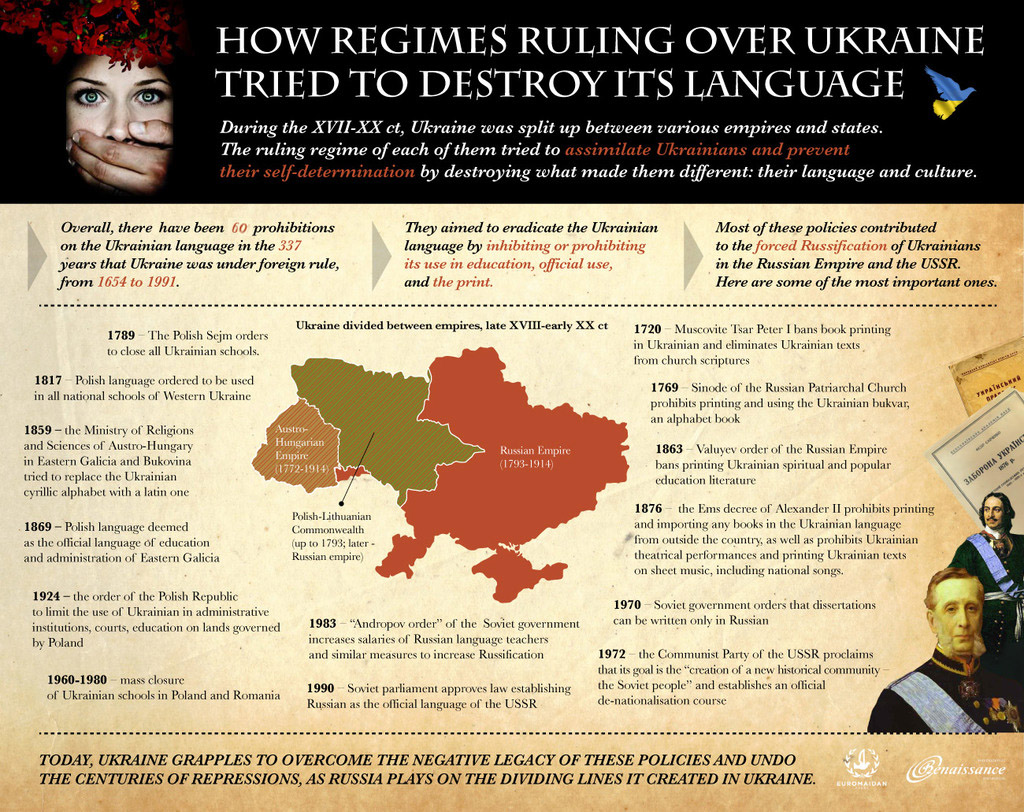
Throughout history, the Ukrainian language has faced numerous bans and restrictions aimed at eradicating its use and diminishing its significance.
Euromaidan Press
The historical suppression of the Ukrainian language encompasses a long period marked by a series of rigorous bans, restrictions, and policies aimed at diminishing its presence and significance in society. These efforts were not isolated incidents but part of systematic attempts to assimilate Ukrainian culture and language into the dominating imperial narratives of Tsarist Russia and later, the Soviet Union.
In the 19th century, Tsarist decrees severely restricted the use of Ukrainian. The Ems Ukase of 1876, for example, was a secret imperial decree that prohibited the importation and publication of Ukrainian literature in the empire. It also banned the use of Ukrainian in stage performances and lectures, significantly limiting the language’s public presence and cultural expression.
The suppression intensified under Soviet rule, particularly during the era of Stalin. The 1930s witnessed a harsh crackdown on Ukrainian cultural and intellectual elites in an effort to quash any notions of national identity that could threaten Soviet unity. Ukrainian language schools were closed, publications were banned, and intellectuals were persecuted, with many facing execution or exile. This period, known as the Executed Renaissance, saw the obliteration of a significant part of Ukraine’s cultural heritage.
Despite these severe measures, the Ukrainian language endured and continued to be a key element of national identity for Ukrainians. The language not only survived these attempts at suppression but also played a pivotal role in the country’s independence movement in the late 20th century. The resilience of the Ukrainian language and its speakers stands as a testament to their enduring spirit and the central role of language in the preservation of cultural identity.
Language and Politics in Ukraine
Expanding on the intersection between language and politics in Ukraine necessitates a closer examination of the deliberate use of the russian language within the political arena, often promoted by pro-russian elements. This strategy, framed as protecting the rights of Russian-speaking minorities, has been critically reassessed in light of Ukraine’s ongoing war and historical efforts to suppress the Ukrainian language. The passage of the 2019 language law underscores Ukraine’s commitment to reinforcing its linguistic sovereignty, setting a legal framework to expand the use of Ukrainian in public life.
This commitment gained a renewed emphasis after russia’s full-scale invasion in 2022. The unity and resilience demonstrated by the Ukrainian people have been mirrored in a widespread embrace of the Ukrainian language, symbolizing not just a form of communication but a powerful tool of resistance against cultural and political imperialism.
In the context of Ukraine, the use of language transcends mere communication—it’s a declaration of national identity and sovereignty. This reality came to the forefront with the enactment of the 2019 language law, a legislative affirmation of Ukrainian’s central role in the nation’s public life. The law’s introduction and the societal shift towards embracing Ukrainian, especially amid the ongoing conflict, signify a broader national awakening. Ukrainians increasingly see their language as a bulwark against external aggression and cultural imperialism. As the nation unites in the face of adversity, the Ukrainian language emerges as a potent symbol of unity and resistance, reinforcing the indelible link between language and national identity in Ukraine’s quest for self-determination.
The 2019 language law, while a legislative measure, is emblematic of a broader societal shift towards valuing and promoting Ukrainian. The law’s implementation was met with enthusiasm as an overdue affirmation of the language’s rightful place in Ukraine’s educational, political, and public spheres.
This period of linguistic reaffirmation has been further catalyzed by the ongoing conflict, serving as a rallying point for national unity. As Ukrainians from diverse linguistic backgrounds unite against a common adversary, the linguistic landscape of the country continues to evolve, with an increasing number of citizens choosing to learn, speak, and conduct their daily lives in Ukrainian.
Language in Ukraine is not merely a cultural artifact but a political statement, a declaration of identity and sovereignty.
The University of Washington’s College of Arts & Sciences
In conclusion, the interplay between language and politics in Ukraine is a vivid illustration of how linguistic choices can embody political and cultural resistance. The renewed focus on Ukrainian not only counters historical suppressions but also serves as a declaration of the country’s enduring spirit and sovereignty.
Ukrainian Language in Diaspora and Educational Initiatives for Language Preservation
For the Ukrainian diaspora, the language is a vital link to their heritage. Efforts to maintain Ukrainian abroad are manifold, involving cultural festivals, literature, educational programs, and more. These initiatives serve as lifelines that connect Ukrainians around the world back to their roots, ensuring that the essence of Ukrainian identity remains strong and pervasive, no matter the distance from the homeland.
Educational initiatives, in particular, have been instrumental in this preservation process. Ukrainian schools abroad are not just academic institutions; they are community centers where language and cultural traditions are actively taught and celebrated. Through a curriculum that includes language arts, history, and cultural studies, these schools foster a strong sense of Ukrainian identity among the youth. Additionally, they offer a space where the Ukrainian community can come together to celebrate their heritage, share stories, and keep the connection to Ukraine alive.
By promoting the Ukrainian language and culture, the diaspora and educational institutions ensure the vibrancy and continuity of Ukrainian identity worldwide. This global network of Ukrainian speakers and enthusiasts not only preserves the language but also acts as a powerful reminder of Ukraine’s resilience and the unbreakable spirit of its people.
Through these combined efforts, the Ukrainian language continues to be a source of pride and unity for Ukrainians everywhere. The commitment to language preservation among the diaspora and through educational initiatives signifies a broader, collective determination to uphold Ukrainian sovereignty, culture, and identity, reinforcing the bond among Ukrainians across the globe.
Preserving Ukrainian Culture in the Diaspora
The Ukrainian diaspora in the United States actively contributes to keeping Ukrainian cultural traditions and language alive. Through celebrating national and religious holidays, commemorating cultural figures, and hosting thematic events, the diaspora maintains a vibrant connection to Ukrainian heritage. This commitment is explored in an article from the Українознавство journal, focusing on the role of periodical publications in connecting with Ukrainian roots.
Language as a Form of Resistance
Since 2014, the Ukrainian language has become a strong symbol of the nation’s fight for independence and cultural integrity. This movement isn’t just seen within Ukraine’s borders but also among communities worldwide, emphasizing Ukrainian as a core element of national identity. The 2019 language law, which mandates the use of Ukrainian in official settings, highlights this commitment to cultural preservation. It’s a clear stand against assimilation and a celebration of Ukraine’s unique heritage.
The rise of the Ukrainian language reflects a broader struggle for self-determination and serves as a defense against cultural and political encroachment. It’s a vivid example of how language can unite a people, offering a sense of belonging and continuity amidst change. This renaissance of the Ukrainian language connects generations, carrying with it the hopes, struggles, and achievements of the Ukrainian people.
As we consider the role of language in maintaining cultural identity, it’s evident that the efforts to support Ukrainian go beyond mere communication. It’s about keeping a rich history alive, ensuring future generations can access their heritage fully. In this global era, the story of Ukrainian’s revival is a powerful reminder of the importance of nurturing our cultural roots, so they continue to inform our shared future.
The resilience shown in revitalizing the Ukrainian language showcases a community’s determination to celebrate its culture. This act of preservation is crucial, not just for Ukrainians but as a model for other cultures navigating the challenges of modernity and globalization. It’s a call to value and protect our diverse voices, ensuring the tapestry of human expression remains vibrant and varied.